Loading product…

Call us for help!+91-9896793832
Address288, Sector 2, HSIIDC, Industrial Growth Centre, SAHA 133104 Haryana, India
Mail ussales@aticoexport.comLoading product…
Concrete
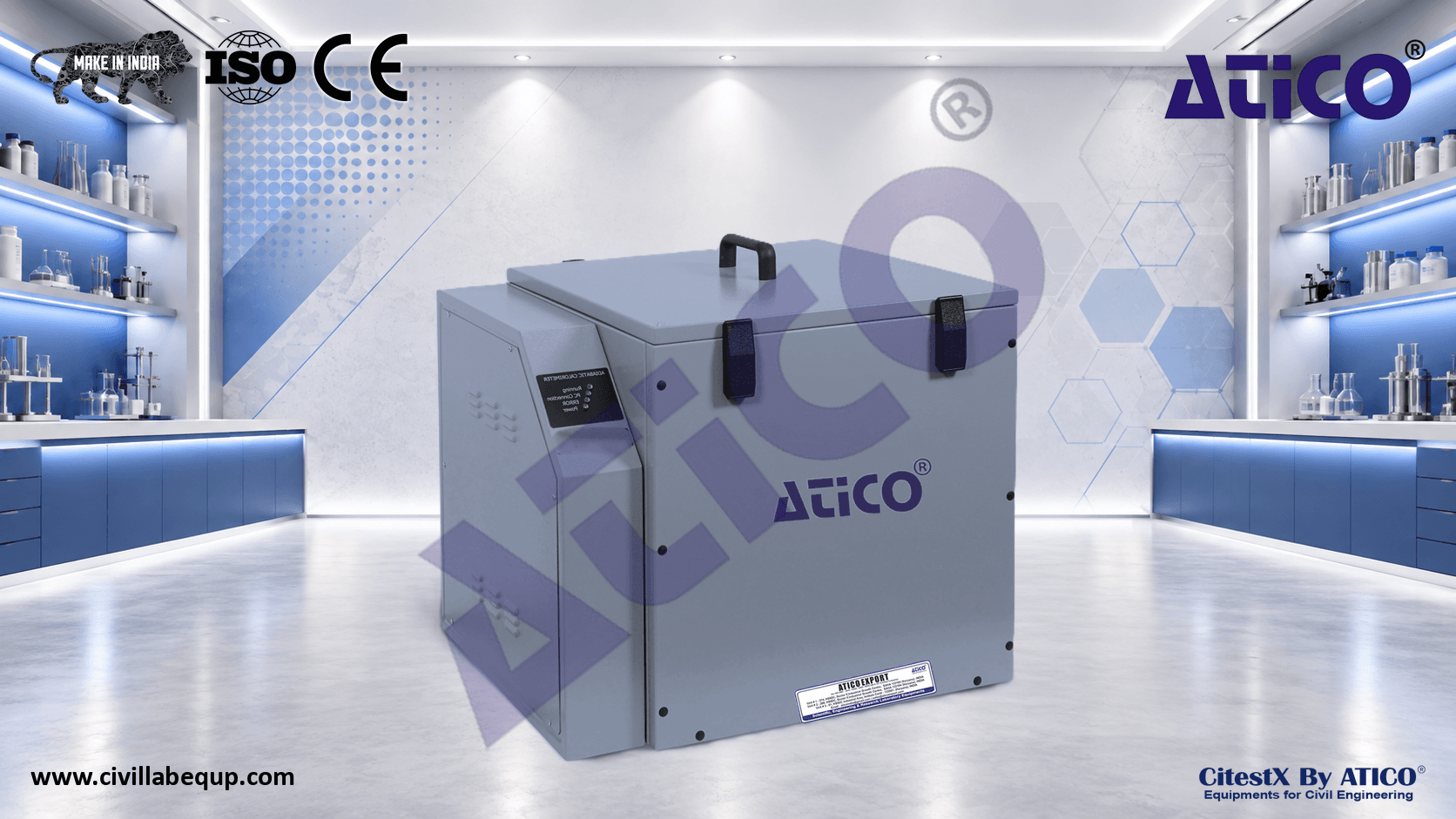
When concrete is curing and hardening, the hydration reaction of cement develops a large amount of heat with an increase in temperature. The temperature rise accelerates the hardening of cement however, if it is not properly dissipated, it can cause the rise of tensile stresses inside the concrete...
When concrete is curing and hardening, the hydration reaction of cement develops a large amount of heat with an increase in temperature. The temperature rise accelerates the hardening of cement however, if it is not properly dissipated, it can cause the rise of tensile stresses inside the concrete structure with the consequent appearance of cracks and reduction of mechanical properties.
This effect is encountered particularly in massive concrete castings, due to the limited heat dispersion, leading the behaviour closer to adiabatic conditions.
The isothermal and semi-adiabatic testing methods are consequently less representative and most commonly used for mortars and cement pastes, basically to compare the behaviour of different types of cement.
The adiabatic method is the only method allowing correct evaluation of the heating process inside massive concrete works.
CONTROLS is the only testing equipment manufacturer that developed in the late 80s, in partnership with the main research laboratories, the first industrial adiabatic concrete calorimeter, so far having been limited to few prototypes in research centers.
Nowadays the equipment has been completely renewed with the latest technologies, including new electronics and PC software, ensuring high testing accuracy.
Working principle
A fresh sample is positioned in a calorimeter cell ensuring adiabatic conditions by avoiding heat exchange with the environment. Since this condition cannot be obtained in practice in a passive system (no insulating material is infinitely non-conductive) the temperature of the room surrounding the specimen is forced to be equal (slightly lower by max 0.5°C) to the temperature of the sample during all the test.
Two PT 100 temperature sensors are used, one positioned in the sample and one in the calorimeter cell. The temperature measurements are used by a PID closed-loop control system to ensure stable sample conditioning according to the Standard requirements.
The equipment consists of:
Max concrete temperature: 80°C (some types of material -e.g. concrete with accelerating admixtures and/or high cement content- may overcome this value and damage the equipment. Please ask our technicians).